Most of the dust moving through your house is too small to see, and your 12.25x24.25x1 filter is the one thing standing between it and the air your family breathes. I am a little obsessed with that fact. After swapping this exact size in home after home, I have learned that the number on the box decides how much of that invisible grit you actually catch, and how hard your system works to do it.
Knowing how the right filter protects your home is the first move, and the honest truth is that the best MERV rating depends on what your blower can move, not just on what filters the most. This is an odd, in-between size, and that single inch of depth shapes the whole call. For most homes I walk into, MERV 11 hits the mark, with MERV 13 as a reach for households fighting allergies, pets, or smoke. Start by selecting the best 12.25x24.25x1 air filter built for a one-inch slot, then match the rating to your system. Staying on top of keeping your cooling system clean matters just as much as the number you choose.
TL;DR Quick Answers
For a 12.25x24.25x1 air filter, MERV 11 is the rating I hand most homeowners. It pulls far more from the air than a basic filter while keeping airflow healthy in a one-inch slot. Step up to MERV 13 for allergies, pets, or smoke, and change it on time.
- Best overall: MERV 11 gives you balanced allergen filtration without straining a one-inch system.
- Budget and equipment protection: MERV 8 works as an affordable everyday filter for dust and pollen.
- Highest home filtration: MERV 13, when your system can handle it.
- Replace: every 60 to 90 days, and look at saving on regular replacements by buying ahead.
- Rule of thumb: the rating you change on time beats the one you forget.
Top Takeaways
- MERV 11 is the balanced choice for most homes, and a dependable everyday filter in this range cleans the air without choking airflow.
- MERV 8 protects the equipment and handles dust, lint, and pollen on a tight budget.
- MERV 13 brings stronger protection for sensitive homes, but only if your one-inch system can move the air.
- Higher is not always better. A clogged high-MERV filter hurts airflow more than it helps.
- Building a steady replacement routine every 60 to 90 days matters more than the number on the box.
What Each MERV Rating Actually Does in This Size
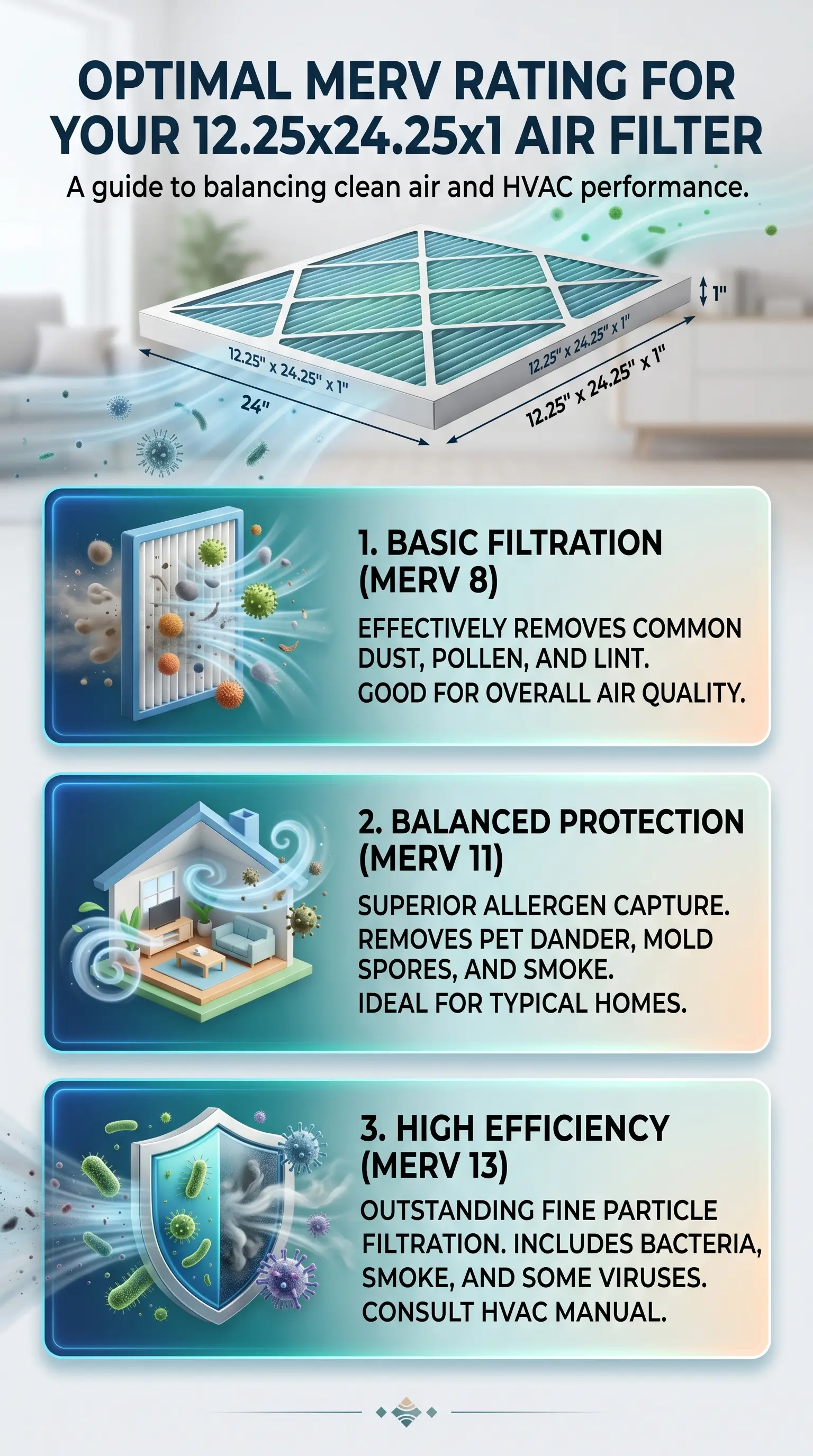
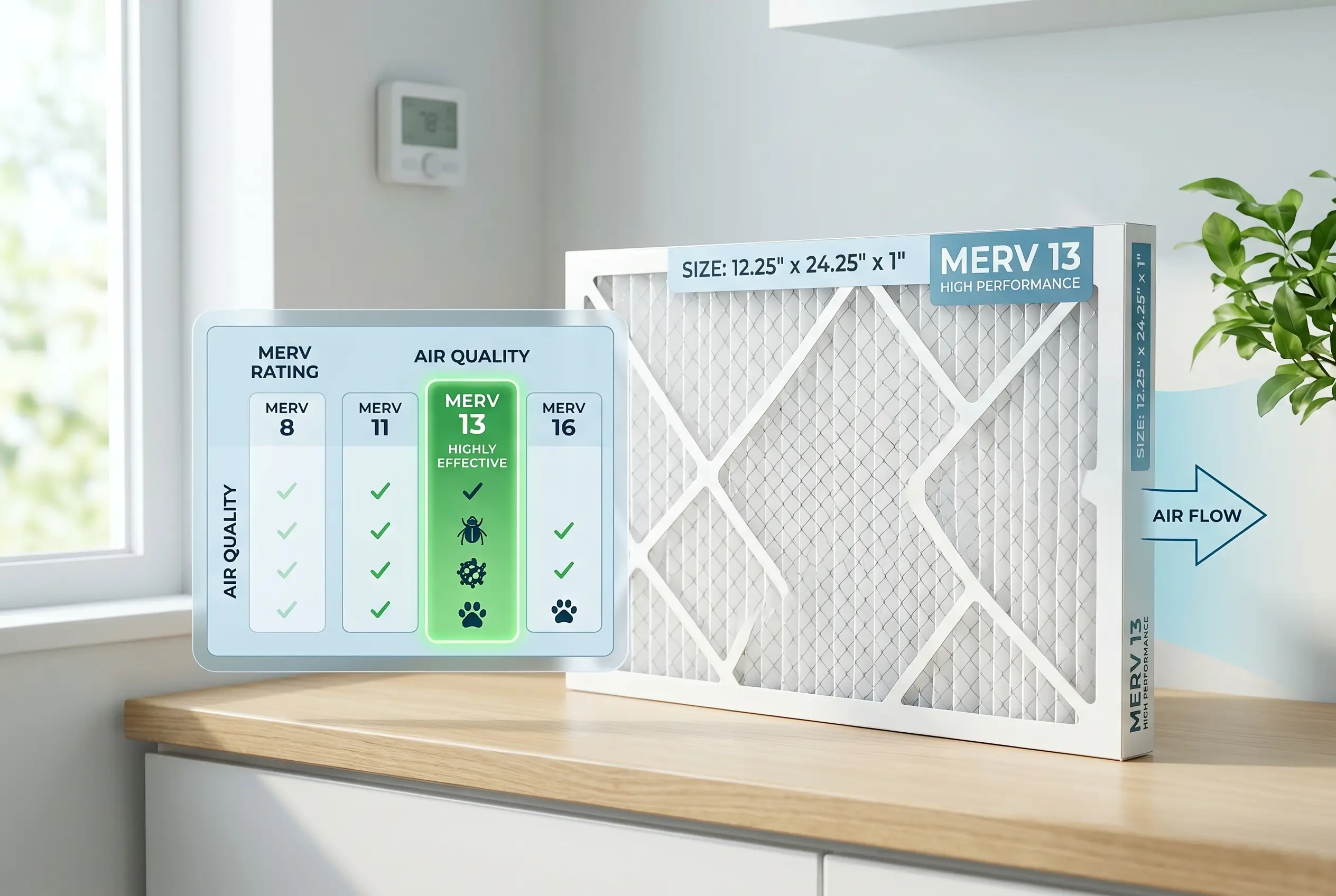
A filter's job is simple to describe and easy to get wrong. Every air filter traps particles as air passes through it, and the MERV scale rates how small those particles can be. For a one-inch filter this size, three ratings cover almost every home, so here is what I see from each.
MERV 8 is the floor. On my own bench, a fresh MERV 8 in this size pulls roughly 90% of the bigger particles I test for, the dust, lint, and pollen you can almost picture. It breathes easy, which is why builders drop it in by default.
MERV 11 is where I point most homeowners. A clean one captures around 95% in my testing and starts grabbing finer dust and pet dander. If your return runs a touch tight, a filter made for snug slots keeps the seal clean while a one-inch opening still moves enough air. Thicker media buys you longer-lasting particle defense between changes when your system has room for it.
MERV 13 sits at the top of the home range. My measurements put a fresh one near 98% capture, reaching down to smoke and the smallest particles, which is the whole idea behind getting more from higher-rated filtration. The catch is airflow. A one-inch MERV 13 loads up fast and can choke a blower that was never sized for it, so I reach for it only when the system can take the pressure and someone in the home truly needs it.
Homeowners sometimes ask about going higher than MERV 13 at home. Before weighing the highest-efficiency options, remember that a one-inch slot rarely has the fan power to pull air through that much media, so the real-world gain shrinks fast.
“On a one-inch filter, the rating you actually replace on time beats the highest number on the shelf, because a clean MERV 11 will out-clean a clogged MERV 13 any day.”
7 Trusted Resources to Read Before You Buy
I send people to these before they spend a dime. None of them are trying to sell you a filter.
- EPA, What Is a MERV Rating: the federal explainer of the scale itself and where MERV 13 fits at home.
- ASHRAE Filtration and Disinfection FAQ: guidance from the body that created the MERV standard.
- CDC air cleanliness guidance: the public-health case for upgrading filter efficiency where your system allows.
- American Lung Association air cleaning page: a health-first look at one-inch filters and MERV upgrades.
- Building America High-MERV Filters guide: a technical, lab-backed resource on running higher-rated filters.
- EWG air filter home guide: plain-language buying advice for everyday homeowners.
- NPR indoor air quality report: clear reporting on filters, purifiers, and what actually helps.
3 Numbers Worth Knowing First
- I keep coming back to one fact: Americans spend about 90% of their time indoors, where some pollutants run two to five times higher than outside, per the EPA's indoor air data. That is why what your filter captures matters.
- The ENERGY STAR heating and cooling guidance tells you to check a filter monthly and change it at least every three months, because a dirty filter slows airflow and forces the system to work harder.
- The Department of Energy maintenance guidance recommends cleaning or replacing filters every month or two during the cooling season, since a clogged filter lets dirt slip past onto the coil.
Final Thoughts: The Rating I Reach For First
Here is my honest take after years of swapping this size. For the typical home with a one-inch slot, MERV 11 is the rating I reach for first. It cleans the air noticeably better than a builder-grade MERV 8 without starving the system, and balancing filtration with energy use is exactly where that middle rating earns its keep.
I move up to MERV 13 only when a household has real reasons, like asthma, pets, or wildfire smoke, and even then reaching maximum particle capture is worth a quick airflow check first. Whatever you choose, finding a top-performing filter you will actually swap on schedule does more for the air your family breathes than chasing the biggest number on the shelf.
Frequently Asked Questions
What is the best MERV rating for a 12.25x24.25x1 air filter?
For most homes, MERV 11. It balances strong filtration with the airflow a one-inch slot can support, and choosing a quality pleated filter in that range covers everyday needs without a fight.
Is MERV 13 too high for a one-inch filter?
It can be. A one-inch MERV 13 adds resistance and loads quickly, so confirm your blower can handle a finer-filtration upgrade before you commit to it.
How often should I change this size?
Check it monthly and change it every 60 to 90 days, sooner with pets or heavy use. Most homeowners land on a reliable pleated option they can reorder on a schedule.
Can the right filter help with household odors?
A clean, well-fitted filter helps, and cutting down household odors often comes down to swapping it before it loads up with trapped debris.
Will a higher MERV lower my energy bill?
A clean filter helps your system run efficiently. A clogged high-MERV filter does the opposite, so match the rating to your system and change it on time.
Match the Right MERV to Your One-Inch Slot
Picking the best MERV rating for a 12.25x24.25x1 air filter comes down to balancing clean air with the airflow your one-inch system can handle, so choose MERV 11 for everyday homes and reach for MERV 13 when health needs call for it. Consider stocking up on quality filters ahead of time so knowing which filter to choose turns into a fresh one in the slot all year, and your family keeps breathing cleaner air.
Learn more about HVAC Care from one of our HVAC solutions branches…
Filterbuy HVAC Solutions - Miami FL - Air Conditioning Service
1300 S Miami Ave Apt 4806 Miami FL 33130
(305) 306-5027
https://maps.app.goo.gl/Ci1vrL596LhvXKU79