Whistling Return Vent? Check How Your 12.5x24x1 Air Filter Is Seated
TL;DR
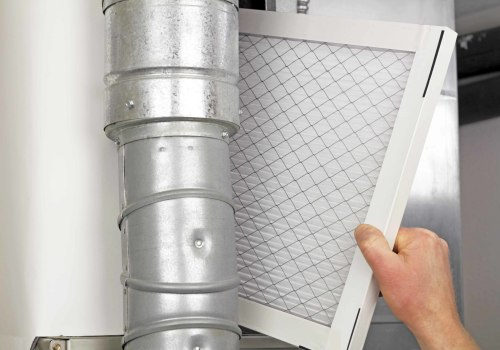
A whistling return vent means air is squeezing through an opening too small for the volume your blower moves. On systems that take a 12.5x24x1 filter, the cause is usually fit. That nominal size measures about 12.5 by 24 by 0.75 inches, so a substituted panel leaves a gap that air screams through. Pull the filter, run the blower ten seconds, and listen. If the whistle stops, you found it.
Key Takeaways
- A whistle is a velocity sound. A rattle is a loose-part sound. Different causes, different fixes.
- Measure the slot, not the old label. Nominal sizes are rounded and actual sizes are not.
- A bowing filter reports high pressure across it. It is loaded, or too restrictive for that opening.
- ENERGY STAR advises checking monthly and replacing at least every three months, and saving on regular replacements makes that routine easier to keep.
- If the noise persists with no filter installed, the return path itself is undersized.
Why Does My Return Vent Whistle?
A return grille whistles when the blower demands more air than the opening can pass without speeding it up. Fast air across a hard edge or through a narrow slot makes a tone, the same way blowing across a bottle does. The blower is not louder. The air is faster through a smaller hole.
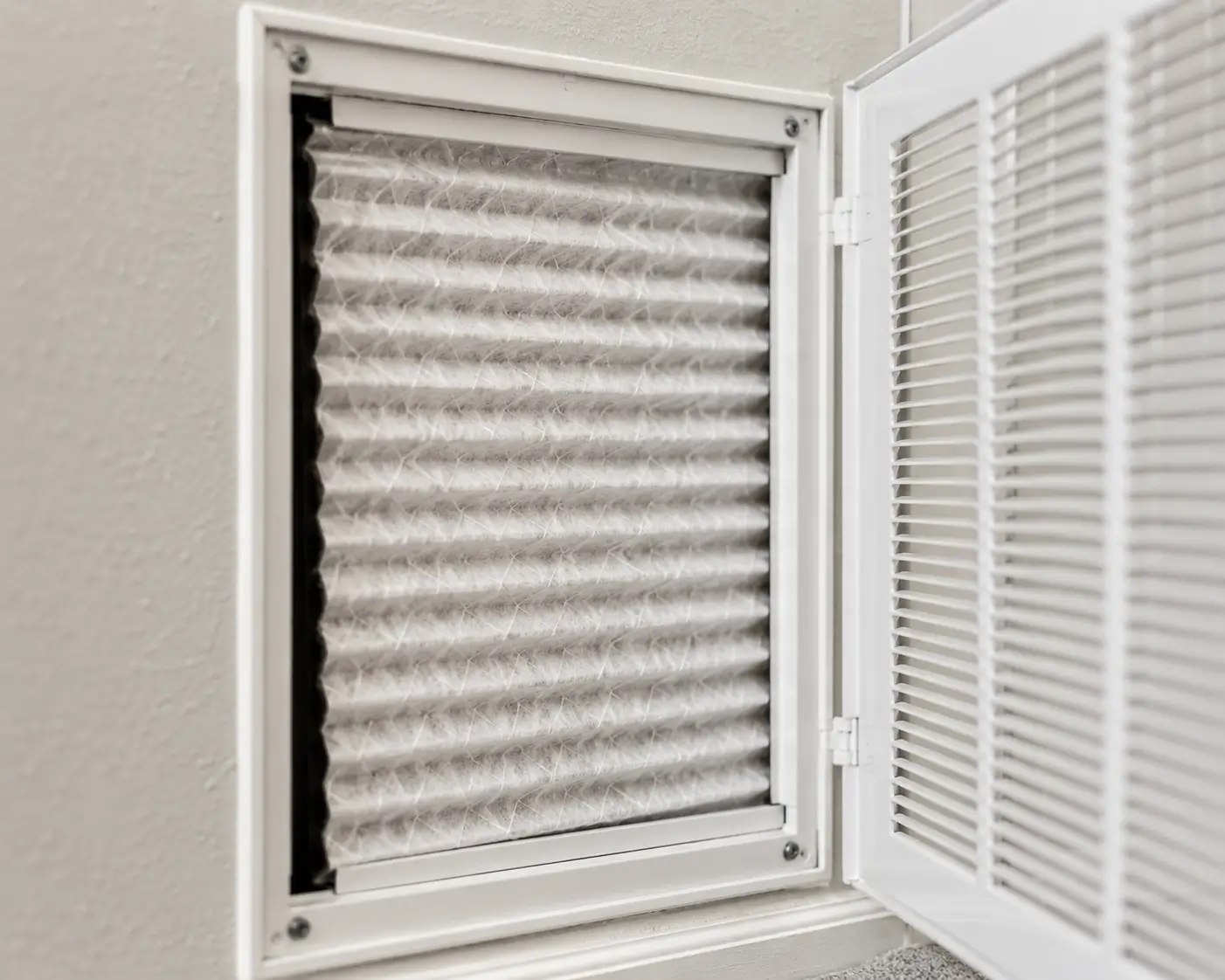
I check the filter first because it is the only part of the return path that changes on its own. Ducts and grilles stay the size they were installed at. An air filter loads with dust, gets swapped for the wrong size, or goes in crooked. One that ran quiet in March can whistle by August.
Whistle Or Rattle? What Each Sound Tells You
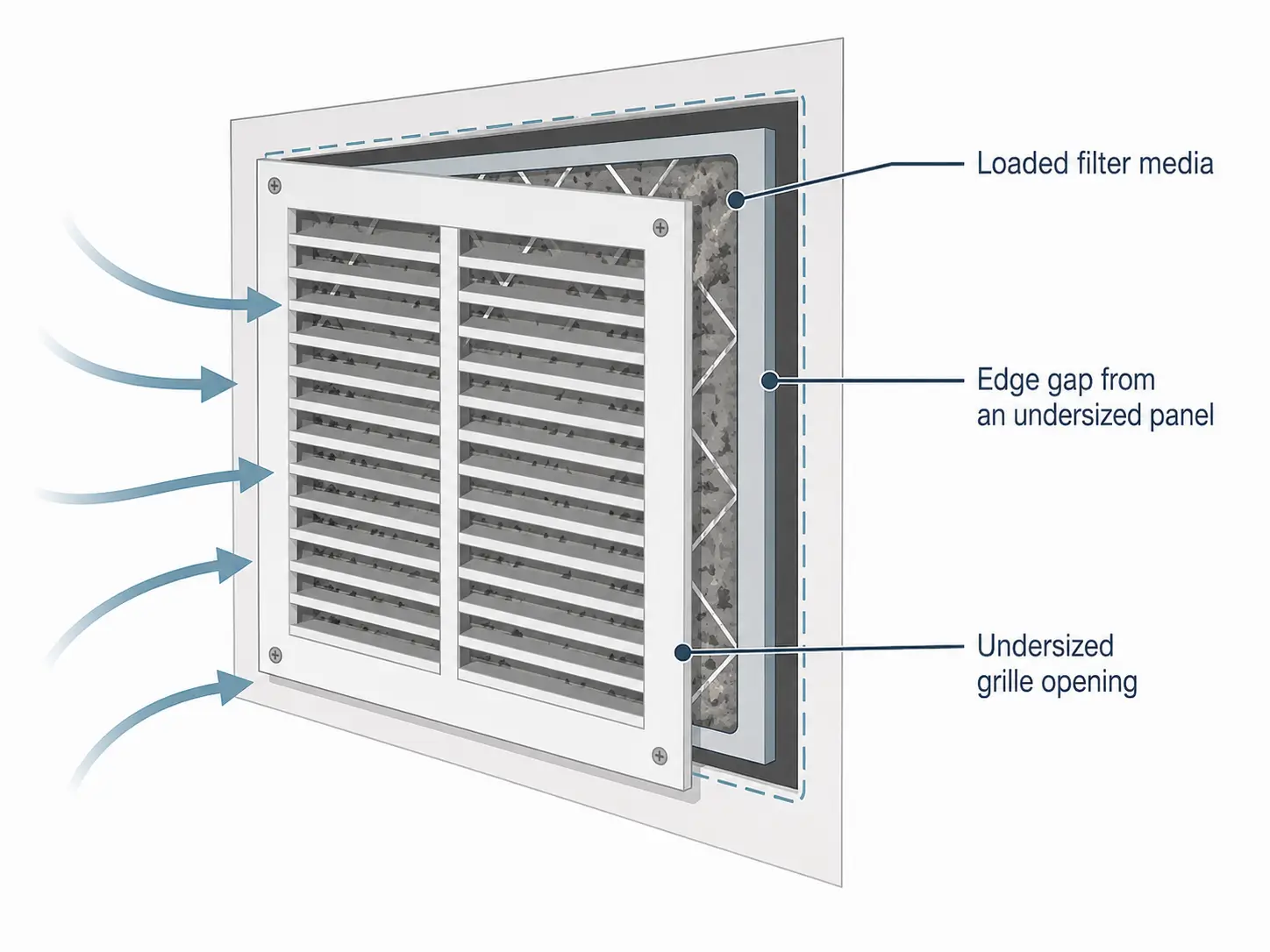
A whistle is a steady tone that rises and falls with blower speed. Air is squeezing through something narrow: a gap along an undersized panel, a blocked media face, or a grille with too little open area.
A rattle is intermittent and mechanical. Something solid is vibrating. Usually the filter frame shifting in an oversized track, a grille door missing a screw, or a cardboard edge flexing against sheet metal.
Both often trace to one sizing error. A panel a quarter inch short leaks air at its edge and shifts in its track, so you get the tone and the buzz from the same mistake. Sort the noise into one of those two buckets before ordering anything.
Why 12.5x24x1 Is Easy To Get Wrong
Odd sizes get substituted. When a homeowner cannot find this size on a shelf, the temptation is to grab something close.
A 12x24x1 panel looks like a near match. It is not. That size measures about 11.5 by 23.5 by 0.75 inches, which leaves close to a full inch of open slot across the width. Air takes that slot fast and carries unfiltered dust past the media.
A 12.25x24.25x1 panel is a different nominal size with its own actual dimensions. Forcing a slightly oversized panel bows the media, and bowed media whistles along the crease. If that is your size, the MERV trade-offs there are a separate decision from fit.
The detail that resolves most of this: nominal filter sizes are rounded estimates, and actual sizes are not. Before ordering, I check that the listing publishes actual dimensions. Pages that state both, such as this reference on 12.5x24x1 air filter sizing and MERV options, make the comparison against your slot straightforward, and a panel built for a snug fit that stops edge bypass beats one that sits loose.
Measure the opening with a tape. Buy against that number, not against the panel you pulled out, which may have been wrong all along.
Which Rating Fits A One-Inch Slot
Rating changes resistance, and resistance is what makes noise. Three ratings cover most homes.
- MERV 8 handles everyday dust and pollen protection and breathes easily.
- MERV 11 gives stronger allergen capture without choking airflow, which suits most one-inch returns.
- MERV 13 delivers the finest particle filtration a home needs, but it loads fast in a shallow slot.
Thicker media buys longer-lasting particle capture when your cabinet has depth for it. Before weighing the highest-efficiency options, remember that a one-inch slot rarely has the fan power to pull air through that much media. Anyone curious about stepping up to finer particle filtration or why maximum filtration appeals to some homes should confirm airflow first, since balancing filtration against energy costs is where the middle ratings earn their keep.
Why Is My Air Filter Sucking Into The Return Vent?
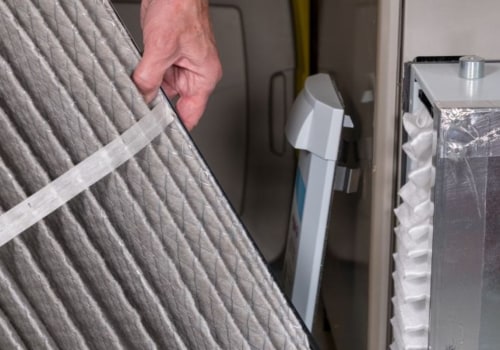
A filter that bows, curls, or slips past its clips is reporting a pressure problem.
The filter is loaded. Dust has closed off enough media that the blower pulls hard against what remains. Replacement fixes it.
The filter is too restrictive for that return. On a grille sized for a basic panel, jumping several MERV steps pushes resistance past what the opening was designed for, which is the trade-off behind any move up to MERV 13. ENERGY STAR's guidance on heating and cooling your home efficiently notes that a dirty filter slows airflow and makes the system work harder. The same physics applies to a clean filter that is simply too dense for its opening.
If a fresh panel of the same rating bows within days, change the rating rather than the brand. Choosing a quality pleated panel one step lower usually settles it.
A Five-Minute Test To Find The Source
1. Set the blower to continuous so the sound holds steady.
2. Stand at the grille. Note whether you hear a steady tone or an intermittent buzz.
3. Slide the panel out. Run the blower briefly with the door closed and no filter in. Do not run unfiltered longer than a minute or two.
4. Listen again. Tone gone means the filter was the restriction. Tone unchanged means the grille or duct is.
5. Put the filter back, close every interior door, and listen once more. Noise that appears only with doors closed points to return pathway starvation.
That last step separates a five-dollar problem from a duct problem.
When The Noise Is Not The Filter At All
The U.S. Department of Energy's Building America Solution Center, in its guidance on return air pathways and transfer grilles, describes a familiar complaint: forced-air systems that seem noisier or seem to work harder than they should. One documented cause is inadequate return air pathways creating pressure imbalances when doors close.
Two numbers are worth knowing. ENERGY STAR's new-homes program asks that closed rooms sit within 3 Pascals of the main body of the house, allowing 5 Pascals for rooms receiving 150 cfm or more. Building America suggests at least one square inch of free grille area for every cubic foot per minute of supply air to a room.
If your bedrooms slam against the pressure, no filter purchase fixes it. Building America's guide to pressure balancing supply and return ducts notes that enlarging a return often calls for a baffle or a turned collar, so the bigger opening does not become its own noise source. That is contractor work.
Essential Resources for Choosing a 12.5x24x1 Air Filter
Seven sources worth reading before you spend money, plus one guide to knowing which filter to choose.
Match the MERV Rating to What Your Slot Can Handle
The EPA lists capture efficiency by rating and says go as high as your fan and slot allow.
Best for: choosing between MERV 8, 11, and 13.
https://www.epa.gov/indoor-air-quality-iaq/what-merv-rating
Confirm Your Filter Is Properly Sized and In Service
The CDC names both failure points that make a return grille whistle.
Best for: checking your install against a federal standard.
https://www.cdc.gov/niosh/ventilation/prevention/air-cleanliness.html
See Where a One-Inch Filter Sits in the Return Path
The American Lung Association covers exactly this setup and what upgrading does.
Best for: understanding what a return-grille filter can clean.
https://www.lung.org/clean-air/indoor-air/protecting-from-air-pollution/air-cleaning
Decide Whether Filtration Will Help Your Symptoms
Allergists explain when whole-house filtration beats a room air cleaner.
Best for: households weighing filtration against allergy symptoms.
https://acaai.org/allergies/management-treatment/living-with-allergies/air-filters/
Fix the Dust Sources a Filter Cannot Reach
Humidity control and cleaning routines that have to happen alongside filter changes.
Best for: homes where dust returns faster than any filter catches it.
https://aafa.org/allergies/prevent-allergies/healthier-home-indoor-air-quality/
Check the Research Before Paying for a Higher Rating
Peer-reviewed measurement of what MERV 12 and higher actually removed.
Best for: readers who want data behind an upgrade.
https://pmc.ncbi.nlm.nih.gov/articles/PMC4133967
Choose Between an HVAC Filter and a Portable Cleaner
The EPA compares the two, including what neither one will fix.
Best for: deciding whether a better filter is enough.
https://www.epa.gov/indoor-air-quality-iaq/guide-air-cleaners-home
Supporting Statistics
1. Undersized return grilles are the main cause of restricted airflow.
- 44% of audited air conditioners had improper airflow.
- Average external static pressure: 0.55 in. w.c. against a 0.10 rating basis.
- Result: about 10% of rated sensible cooling capacity lost.
- Sample: 4,168 air conditioners.
Florida Solar Energy Center, University of Central Florida (2018), citing Mowris et al. 2004
https://publications.energyresearch.ucf.edu/wp-content/uploads/2018/09/FSEC-PF-474-18.pdf
2. Most residential systems were never installed to spec.
- More than 65% are estimated to be performing below spec.
- Insufficient indoor coil airflow is a leading fault type.
U.S. Department of Energy, Field Study to Characterize Fault Prevalence in Residential Comfort Systems
3. Two-thirds of U.S. homes have a ducted return with a filter in it.
- Central AC or a central heat pump is the main cooling equipment.
- Roughly 82 million homes.
- Sample: 18,496 households.
U.S. Energy Information Administration, 2020 Residential Energy Consumption Survey
https://www.eia.gov/todayinenergy/detail.php?id=52558
Glossary
Nominal size. The rounded name a filter is sold under. It is a label, not a measurement.
Actual size. The real measured dimensions of the panel, typically a fraction smaller than nominal.
Filter bypass. Air traveling around the edge of a filter instead of through it. A common source of edge whistling.
Static pressure. The resistance air meets moving through ducts, filters, and coils. Rising static pressure turns an ordinary return into a noisy one.
Frequently Asked Questions
Will a lower MERV rating stop the noise?
It can, if the current panel is too restrictive for the opening. Drop one step, not several, and watch whether the bowing and the tone resolve. A reliable pleated option in the middle range suits most one-inch returns.
How often should I change a filter this size?
Check monthly and replace at least every three months, sooner with pets or continuous fan use. Buying ahead so changes actually happen is what keeps the schedule real.
Is a small gap around the filter acceptable?
No. Any gap becomes the preferred path for air, which is both the noise source and a filtration bypass.
Can the right filter help with household odors?
A clean, well-fitted panel helps, and cutting down household odors often comes down to swapping it before it loads up.
What I Would Do Next
Measure your return slot today and write the number down. Compare it against the actual dimensions of whatever you plan to buy. Keeping your cooling system clean matters as much as the rating you pick, and building a steady replacement routine beats chasing the highest number on the shelf. Finding a top-performing filter you will actually swap on schedule does more for your air than any upgrade. Most whistling returns trace back to a half-inch of guesswork, and a tape measure settles it for free.
Learn more about HVAC Care from one of our HVAC solutions branches…
Filterbuy HVAC Solutions - Miami FL - Air Conditioning Service
1300 S Miami Ave Apt 4806 Miami FL 33130
(305) 306-5027
https://maps.app.goo.gl/Ci1vrL596LhvXKU79